

The small wind turbine guide
France reportedly had more than 650 small wind turbines in 2009. Whether you are an individual or head of a company, you may be considering producing your own electricity. With a power range from 100 watts to 30 kilowatts (Ademe classification), small wind turbines are a solution to consider. However, it is essential to ask the right questions, answer them of course... and in the right order!
Introduction
Harnessing wind energy is simple in theory, but more complex in practice. Indeed, Aeolus, the god of the winds, has a nasty habit: he often changes moods and sometimes gets angry. Yet, a wind turbine must produce electricity over a wide range of wind speeds and withstand strong gusts. Moreover, its longevity and reliability determine the return on investment. Therefore, the choice of equipment is particularly important. While it is possible to acquire and install a low-power system on your own, implementing a wind generator of more than 5 kW requires professional intervention. The installer will study the needs and the wind, determine the best solution based on the budget and project profitability, and handle the sometimes laborious administrative procedures.
This guide aims to help you refine your project and give you the keys to engage "on equal terms" with industry professionals.
Site Eligibility
Before starting, it is important to ensure the feasibility of the project and its limitations on two aspects:
- Is the resource sufficient? In other words: does the wind blow often enough and strong enough?
- What am I allowed to install at the planned location?

The wind study
The presence of an old windmill near the land seems promising... Even better, if wind turbines have already been erected in the same area, there must be potential. In reality, not so sure!
Ademe offers on its website a map of France's wind resources. The agency's regional branches even provide more precise local maps (see example in Pays de Loire). Useful, but insufficient for making a
decision, especially since the measurements are taken between 50 and 60 meters high.
Result: to ensure your project, it's better to have a wind study conducted.
The departmental agencies of Météo France sell "wind roses" that allow you to visualize the direction and average intensity of winds over a given period, ranging from a week to several years, for a specific weather station. For €38 excluding VAT (2009 rate), you thus have essential data, but still insufficient. Indeed, unless you live a few meters from the station, the intended land does not necessarily offer the same wind, as it is affected by the terrain, vegetation, and nearby constructions. Therefore, an on-site measurement over the longest possible period is necessary, ideally at different heights. This wind measurement is carried out using an anemometer and a weather vane placed on a mast and connected to an electronic recording box (the "logger"). The wind rose of each measurement height is then compared to that of the weather station for the same period. A "correlation coefficient" between the station and the land in question is deduced. Applying this coefficient to a Météo France wind rose over several years gives a good indication of the wind potential.
Conducting a preliminary wind study before installing small wind turbines costs, depending on its complexity, duration, and precision, between €600 excluding VAT (1 month at 12 meters, basic study) and €5000 excluding VAT (3 months at 30 meters, in-depth study). An amount sometimes reimbursed by the installer in case of an order. The rental of a recording anemometer is charged between €500 and €1000 per month.
Regulatory elements
Administrative procedures can be complicated and especially long. Ideally, the task should be entrusted to the installer.
Building permit
The interest of measuring the wind potential at several heights makes perfect sense from a regulatory point of view. Indeed, no formalities are officially necessary to erect a wind turbine less than twelve meters high (excluding blades). More precisely, "are exempt from any formalities under this code, due to their nature or very low importance, unless they are located in a protected area whose perimeter has been defined or in a classified site: wind turbines whose mast and nacelle height above the ground is less than twelve meters" Article R421-2 of the Urban Planning Code.
In practice, most municipalities require a prior declaration of work for wind turbines less than twelve meters high. If the land is near a classified site, consulting the servitude plan, an annex of the Land Use Plan (POS) or the Local Urban Plan (PLU), allows you to know the protected perimeter. A municipality can also prohibit the installation of wind turbines, even outside any protected site, by clearly indicating it in its PLU or POS. To be checked at the town hall... Of course, there is no question of starting the installation of a wind turbine on the beach (100-meter strip, Coastal Law).
Furthermore, the municipality can oppose a wind turbine project if it considers that too much nuisance would be inflicted on the neighbors of the energy production candidate. It is therefore better to get along well with your neighbors before embarking on such a project... or with the mayor!
And of course, wait a month after your work declaration before starting them. For wind turbines over twelve meters, a building permit is mandatory (as well as an impact notice, if it is less than fifty meters, the most common case for small wind turbines)
In municipalities without a PLU (therefore still under the POS regime), the building permit is submitted to the prefect. In municipalities with a PLU, or when the wind turbine is intended for self-consumption use, the building permit is issued by the mayor. The examination of the building permit is supposed to take two months. In reality, it usually takes nearly ten months to obtain the precious permit.
Authorization to produce electricity
Small wind turbines are subject to a declaration with the energy directorate (DGEC) of the Ministry of Ecology. This procedure can be done online on the AMPERE website.
Authorization to connect the wind turbine to the grid
It does not concern installations in "isolated sites," that is, not connected to the grid. However, as soon as the building to be powered is connected to the grid, even if the entire production will be self-consumed, a connection request is necessary. The request is made to Enedis (formerly ERDF), specifically to the ARD service of the concerned region.
Authorization to sell your electricity
To be able to sell your surplus electricity to an operator (EDF, Poweo, Direct Energie...), other procedures are necessary.
• If the installation is located within a WDA (Wind Development Area), the producer benefits from the "purchase tariff." This means that all the electricity it produces is subsidized, in other words, bought by EDF at a rate higher than its own selling price. As of September 1, 2009, this purchase tariff was 8.2 c€/kWh. It decreases depending on the age of the installation and its productivity. Wind production will be subsidized for projects completed until at least 2012, and for a maximum duration of fifteen years.
To benefit from the purchase tariff, it is not enough for the wind turbine to be located in a WDA. First, a "certificate granting the right to the purchase obligation" (CODEA) must be requested from the local DRIRE (Regional Directorate of Industry, Research, and Environment). Then, finally, a purchase contract request must be made with EDF or another operator if applicable.
• If the installation is not located in a WDA, it is possible to sell the surplus or all of its production directly to an electricity supplier approved by RTE (Electricity Transmission Network Manager) called a "balance responsible party." Several operators already offer this service, including Poweo, Direct Energie, or Enercoop (complete list on the RTE website).
The buyback price offered by these companies ranges from 4 cents to 8 cents per kWh excluding VAT (generally indexed to the European electricity market PowerNext). Interesting for a company that recovers VAT on its electricity purchases. Much less so for an individual, who de facto pays including VAT but sells excluding VAT…
The prohibition of making noise
The question of noise remains. The Public Health Code does not provide for a minimum distance to be respected. However, it stipulates that the additional sound exposure (sound emergence) of surrounding dwellings must not exceed three decibels at night and five decibels during the day (measured outside).
The declaration of works in practice
(excerpt from the receipt of submission of a prior declaration)
You have submitted a prior declaration for works or developments not subject to a permit. The processing time for your file is one month, and if you do not receive any mail from the administration within this period, you will benefit from a decision of non-opposition to these works or developments.
However, within the month following the submission of your file, the administration may write to you:

- either to inform you that another deadline is applicable, when the urban planning code has provided for it to allow necessary consultations (if your project requires consultation with other services…);
- or to indicate that one or more documents are missing from your file;
• If you receive such a letter before the end of the month following the submission of your declaration, it will replace this receipt.
• If you have not received anything by the end of the month following the submission of your declaration, you may begin the works after having:
- posted this receipt on the site, on which the town hall has stamped to certify the date of submission;
- installed on the site, for the entire duration of the construction, a sign visible from the public road describing the project. You will find the sign model at the town hall, on the government's urban planning website, as well as in most building material stores.
Attention: the decision of non-opposition is only final in the absence of an appeal. Indeed, within two months from its posting on the site, its legality can be contested by a third party before the administrative court. In this case, the author of the appeal is required to inform you no later than fifteen days after the filing of the appeal.
Define your needs
Some dream of unsubscribing from EDF out of defiance. The most eco-friendly don't care about profitability. Others aim for a quick return on investment, even if it means paying the price. The most reasonable wish to lighten their bill. The most ambitious aim to reduce it to zero thanks to their surplus production. Entrepreneurs value the positive communication brought by the visible presence of a wind turbine in their factory… Unfortunately, achieving all these objectives simultaneously and in the current state of affairs remains impossible. A choice must be made.
Pumping wind power
Fully mechanical multi-blade wind turbines connected to a water pump are still available on the market. They allow the exploitation of a well too far from a power source to be equipped with an electric pump. Very sturdy, the most powerful ones draw between 500 and 1500 liters/hour and have a lifespan of 50 years.
Technical elements influencing the choice
General elements on performance
Generally speaking, the wind range allowing a wind turbine to operate extends from 15 km/h to less than 100 km/h. Beyond this, a safety system triggers the rotor's shutdown for safety reasons. For the same location, better performance is achieved by placing the wind turbine as high as possible. By placing the nacelle at
25 meters high instead of 12 meters, the additional wind almost always compensates for the installation of a longer mast. However, one must be prepared to go through the building permit process.

According to RTE, in 2007, the monthly producibility of wind installations varied from 10% to 35% (energy actually produced compared to the maximum theoretically producible energy), with an average annual value of 24%. Consequently, for small wind turbines, one should generally not expect an annual production duration exceeding 2000 hours. Another calculation, a 1 kW wind turbine will produce between 70 and 255 kWh each month and its annual production will peak at 2000 kWh.
At this stage, it is necessary to define more precisely the notion of power for a wind turbine. The figure generally indicated by the manufacturer is the nominal power, which is the power at which its efficiency is highest (energy received / energy recovered). Indeed, the power actually supplied by the wind turbine depends on the wind speed.
The maximum power is called peak power. A 2 kW nominal power wind turbine can thus produce 3 kW at maximum for a reasonable duration.
Therefore, be sure to verify that the indicated power is indeed the nominal power, and not the peak power. Furthermore, a common mistake is to favor a model based on its low-speed performance in the hope of more frequent production. Unfortunately, winds below 3 m/s (10.8 km/h) generate very little energy. Performance between 5 and 15 m/s is very discriminating. For the "math enthusiasts": in its ascending phase, power increases with the cube of the Source RTE wind speed...
Vertical or horizontal?
The vast majority of wind turbines consist of a propeller rotating on a horizontal axis. The first models of vertical-axis wind turbines appeared in the thirties and did not take off due to their low efficiency and blocking technical constraints – the original Darrieus models, for example, had to be started to launch. In recent years, new models (and many projects) of small vertical-axis wind turbines have emerged that should address the weaknesses of their predecessors.
A plethora of options
It is thus conceivable to install a vertical-axis wind turbine if the location offers particularly turbulent winds: urban environment, inability to install a mast, installation on a building. For other cases, a classic model placed sufficiently high will offer the best performance and a faster return on investment.
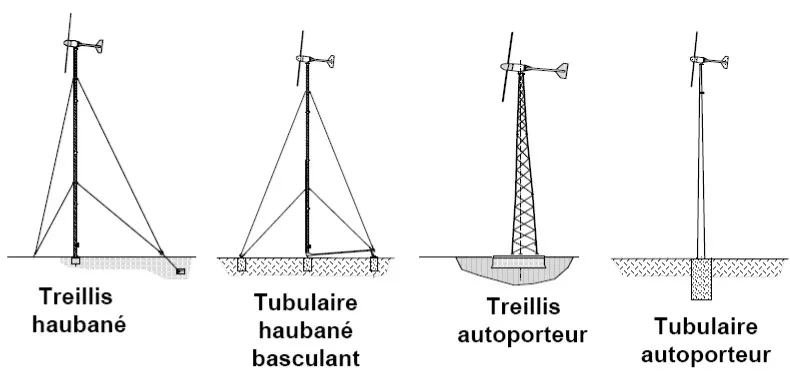
The different types of supports
Guyed masts have the advantage of being the least expensive, but the disadvantage of occupying a lot of space (about 12 m2 for a 2 kW wind turbine). Self-supporting tubular masts are not only much more durable over time but also support much heavier and thus more powerful turbines. They are also appreciated for their aesthetics similar to large wind turbines.
The blades
Small wind turbines rotate quickly. The linear speed at the tip of a blade of a three-blade wind turbine reaches 250 km/h (or 250 to 400 revolutions per minute depending on the length of the blades). The mechanical constraints associated with these speeds are now well managed by most manufacturers.
Four materials are used:
- solid wood and laminated wood: mainly reserved for self-builders.
- aluminum: practically no longer used, as it poorly resists mechanical fatigue and eventually breaks
- composite materials: used by all serious manufacturers.
Regarding size: the longer a blade, the more powerful it is, but the higher the speed at the tip of the blade, and thus the noisier it is.
As for the number: the more blades there are, the more the wind turbine will start with a weak wind, but it will be less powerful... while being more expensive. Therefore, a compromise must be found between the length and the number of blades to achieve the desired performance. The choice will thus be between one (technically possible, but rare) and eight blades, depending on the wind study and the project's needs. Several companies and research laboratories are working on new blade shapes. WhalePower, for example, has launched a project copying the particular shape of whale fins. Le Comptoir Eolien already offers wind turbines with three conical blades.
The blades of small wind turbines are generally "fixed pitch," meaning that the incidence of the blade relative to the plane of the propeller is constant. A "variable pitch" system is much more efficient, as it behaves somewhat like a gearbox, but is also much more expensive. A variable pitch also allows feathering the propeller to protect the wind turbine from strong winds (the blades are oriented so that their lift is zero, while leaving the rotor facing the wind).
Orientation
Needless to say, a wind turbine is more efficient when it is well oriented towards the wind.
Three technical solutions allow for orientation:
• Free system with downwind rotor: The wind first encounters the nacelle, which acts as a rudder, then strikes the blades. This is the simplest system, but it generates immediate turbulence that is detrimental to performance.
• Free system with upwind rotor: This is the most common system for small power outputs. A rudder placed behind the nacelle positions the rotor perpendicularly to the wind, like a weather vane. Free systems (downwind or upwind) are cheaper, but require the installation of a damper to prevent the turbine from racing in turbulent winds.
• Motorized orientation: A weather vane and an anemometer control the rotor's orientation via an electric motor. This system allows the rotor's orientation to be changed only if the wind has shifted permanently. This optimizes productivity. It also protects the turbine in strong winds. This type of system is reserved for the most powerful small wind turbines (from 10kW).
Vertical-axis wind turbines, being inherently omnidirectional, do not require any orientation system.
Resistance to strong winds and regulation
Some wind turbines can withstand winds of nearly 200 km/h. However, most do not reach such high "survival" speeds. They are therefore equipped with systems to shield the rotor from the wind's force. Wind turbines with motorized orientation place the rotor parallel to the wind to protect it or use a brake. Those with variable
pitch blades feather. The less sophisticated ones use either a mechanical avoidance system (the rotor pivots on an axis by pulling on a spring to position itself parallel to the wind)
or a mechanical automatic braking system. Vertical axis wind turbines benefit by design from the "dynamic stall" of the blades, requiring no strong wind avoidance system.
Generator and gearing
The generator's role is to convert the rotational movement of the shaft into electricity. For the small wind power range, it is generally a synchronous alternator with a permanent magnet. The intensity and frequency of the current produced by the alternator vary according to the rotor's rotational speed. Therefore, the electricity output must be regulated to be usable. This regulation is performed by an inverter. Rotors with a rotational speed too low to directly drive a conventional alternator are accompanied by a gearbox, a type of transmission. This component is generally the weak link in the installation, as it undergoes high and constant mechanical stress.
Batteries
Practically indispensable for isolated sites, batteries seriously complicate the profitability
of the installation. The choice criterion lies in the battery's energy storage capacity. Strictly speaking, this capacity is measured in ampere-hours, but it is often easier to express it
as the power produced in one hour by its wind turbine, thus in kWh. A battery capable of storing 1000 Wh (or 1 kWh) can thus retain the equivalent of one hour of wind at nominal speed for a 1 kW wind turbine. Count 150 € excluding tax per kWh for lead batteries, double
for NiCad. Their lifespan ranges from 10 to 15 years for lead models and 20 to 25 years for the most modern ones.
A bit of physics Remember that P=UI!
To determine a battery's storage capacity in kWh, multiply its voltage (12v-24v….) by its capacity in ampere-hours (100 ah for example). Thus, a 24 V battery with a nominal capacity of 150 ah can store 150 x 24 = 3600 Wh = 3.6 kWh = 3h36' of production from a 1 kW wind turbine.
Maintenance
Some low-power models are presented as potentially maintenance-free. However, regardless of its power, annual maintenance is essential to optimize the wind turbine's lifespan. Preventive maintenance is generally annual. Oil replacement, greasing, tightening checks… Plan between 200 and 1000 € excluding tax depending on the power and a day of downtime. The operation involves two to three people.
Regarding corrective maintenance, it should be noted that beyond ten years, material fatigue and wear problems appear, especially in areas where winds are most turbulent. The owner will face operations to replace or repair blades, replace or refurbish the alternator, gearbox. Lightning is also a frequent source of electrical failures.
Wind turbines are generally guaranteed for two years, sometimes three. As for batteries, the warranty rarely exceeds one year.
Price ranges
A small wind turbine generally costs between 3,000 and 90,000 € excluding tax with installation, depending on its power. The price per installed kW decreases rapidly with the total power of the device. If finances allow, it is therefore easier to make a wind turbine profitable that shows the highest possible performance for the available wind conditions and terrain.
Glossary
• Anemometer: Device for measuring wind speed.
• Horizontal axis wind turbine: Wind turbine with a horizontal rotor axis. The propeller plane is therefore vertical. This is the form chosen for large wind turbines and the most common in small wind turbines.
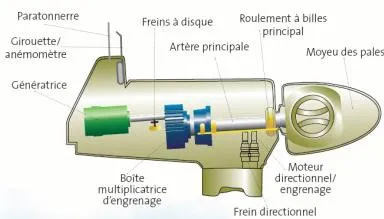
• Vertical axis wind turbine: Wind turbine with a vertical rotor axis. The propeller plane is therefore horizontal. This type of wind turbine currently concentrates a large part of research efforts.
• Darrieus type wind turbine: Vertical wind turbine designed in 1931 by French engineer Georges Darrieus (September 24, 1888 - July 15, 1979). It was built until 1997 by FloWind.
• Savonius type wind turbine: Vertical wind turbine consisting of two or more buckets (hemisphere or half-cylinder).
• Generator (aerogenerator): Alternator or dynamo whose role is to convert the rotation of the rotor axis into electricity.
• Inverter / Rectifier: System for regulating the irregular current produced by a wind turbine to allow its domestic use or injection into the grid.
• Small wind turbine: Installation of wind turbines producing electricity with a nominal power between 1 and 30 kilowatts. Below 1 kW, it is referred to as micro wind turbine.
• Nominal power of a small wind turbine: Power at which its efficiency is highest (energy received / energy recovered). The nominal power of a wind turbine is therefore given for a range of wind speeds.
• Connection to the electrical grid: As the wind turbine depends on the wind, a connection to the electrical grid is necessary. It also allows selling all or part of the wind turbine's electricity production. For small wind turbines and up to 36 kW, the connection is made to the low voltage grid managed by Enedis (formerly ERDF) (Electricity Network Distribution France).
• Power variation of a small wind turbine: The power of a wind turbine depends on the wind speed and varies with its cube. For example, a wind turbine producing 2 kW at 4 m/s will produce 8 kW at 8 m/s.
• ZDE (Wind Development Zones): Variable-sized sites where any installed wind turbine benefits from an operating subsidy in the form of a preferential purchase tariff for its production by EDF.